Fruitprocessingplant.com / Equipment and plant interfaces
Retort Sterilizer
Retort sterilizer for suitable packaged food products.
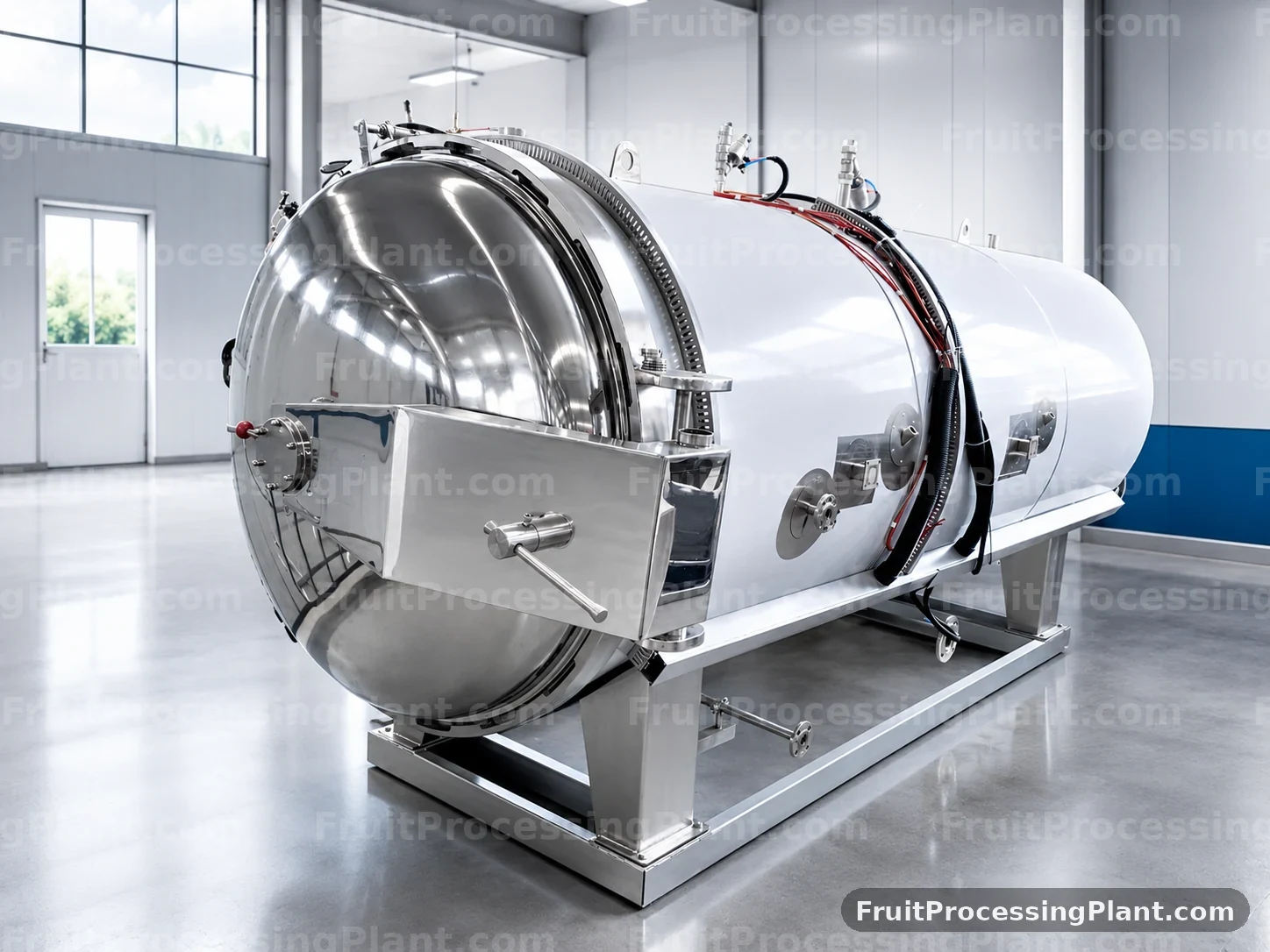
Product and package heat treatment
Product or service input
Sealed packages compatible with the specified retort treatment.
Output and interface
Treated packages handled according to their validated cooling and storage requirements.
View the complete process dutyDiscuss this equipmentSelection boundary
Define product heat penetration, package resistance, load pattern and process-authority requirements.
A generic time-temperature recipe is unsuitable; each product, pack and loading arrangement needs validation.
Cleaning and maintenance
Plan basket handling, vessel inspection, interlocks, calibrated process recording and qualified maintenance.
Information that defines the proposed configuration
A model-specific offer must identify the equipment, verified duty and interfaces. The checks below identify required inputs, not guaranteed machine ratings.
Product properties
Product name, pH, initial Brix, viscosity at a stated temperature, pulp, fiber and maximum particle size.
Rheology and particles determine heat-exchanger geometry, pressure drop and fouling risk.
Capacity and operation
Product flow per hour, batch or continuous duty, operating hours and product change frequency.
Flow rate determines heat-transfer area, holding section and cleaning schedule.
Heat treatment
Inlet temperature, target treatment temperature, holding time, outlet temperature and required process validation basis.
Thermal duty controls heating medium, holding tube and cooling design.
Packaging interface
Aseptic, hot-fill, chilled or retort route, filling temperature, package format and required back pressure.
The package route changes cooling, sterile transfer and SIP requirements.
Utilities and cleaning
Steam pressure and quality, cooling-water temperature and flow, power, compressed air, CIP recipe, SIP requirement and drainage.
Steam, cooling and CIP availability determine achievable capacity and hygienic operation.
Engineering Notes for Retort Sterilizer Selection
Retort Sterilizer is commonly discussed for packaged sauce, jar or can products, batch sterilization projects, shelf-stable packaged foods. The goal is to make this module work as part of a complete fruit and vegetable processing line, not as an isolated catalogue item.
Thermal equipment should be selected from viscosity, pulp content, particle size, acidity, packaging route and target shelf life. Low-viscosity clear juice may suit plate heat exchange, while pulpy juice, puree, sauce or concentrate often requires tubular or tube-in-tube handling. Preheating, holding, cooling, back-pressure and CIP access must be designed as one thermal system rather than as a single machine.
The buyer should provide product pH, Brix, fiber level, particle limits, filling temperature and storage target. Heat treatment that is too mild can create microbiological risk, while aggressive treatment can damage aroma, color and texture. The final sterilization or pasteurization condition must be confirmed by product testing and process validation; values on an early page are only a reference for discussion. The RFQ checklist below should be used to confirm the sizing data before quotation.
- Match heat exchanger type to viscosity and pulp level.
- Confirm holding time, outlet temperature and cooling demand with the packaging plan.
- Review fouling behavior and CIP sequence for sugar, pectin, protein or sauce products.
- Do not finalize shelf-life claims without product validation.
Related planning pages: plate sterilizer for low-viscosity products, tube-in-tube sterilizer for viscous products, and aseptic filling after sterilization. Use them to compare equipment, plant routes and RFQ scope before final quotation.
Equipment FAQ
Which heat exchanger type is appropriate?
Plate systems are commonly discussed for low-viscosity products without large particles. Tubular or tube-in-tube designs are usually considered as viscosity, pulp or particle size increases. Final selection needs measured product data and pressure-drop review.
How is holding time confirmed?
Holding time is based on the product, pH, target microorganisms, packaging route and process authority or validation requirement. Website values are preliminary references and should not replace product-specific thermal validation.
Why must CIP and SIP be discussed with the sterilizer?
Product fouling, sterile boundaries, valve arrangement and filling interface determine how the thermal section is cleaned and sterilized. Treating CIP or SIP as a separate afterthought can create hygiene risk and excessive downtime.
Can Retort Sterilizer be customized?
Yes. Capacity, product-contact or container-contact parts, motor and drive selection, controls, guarding, inlet and outlet arrangement, platform and line interfaces can be configured from the project data listed on this page. Final scope is confirmed before manufacturing.
Why is there no fixed online price for Retort Sterilizer?
The same equipment name can cover different capacity, construction, controls, guarding, accessories and upstream or downstream interfaces. A fixed public price would hide those differences. The RFQ process confirms the required scope before a project quotation is prepared.