Fruitprocessingplant.com / Equipment and plant interfaces
Falling Film Evaporator
Falling film evaporator manufacturer for juice concentration, with target Brix, heat recovery, aroma protection, fouling control, CIP and RFQ-based sizing.
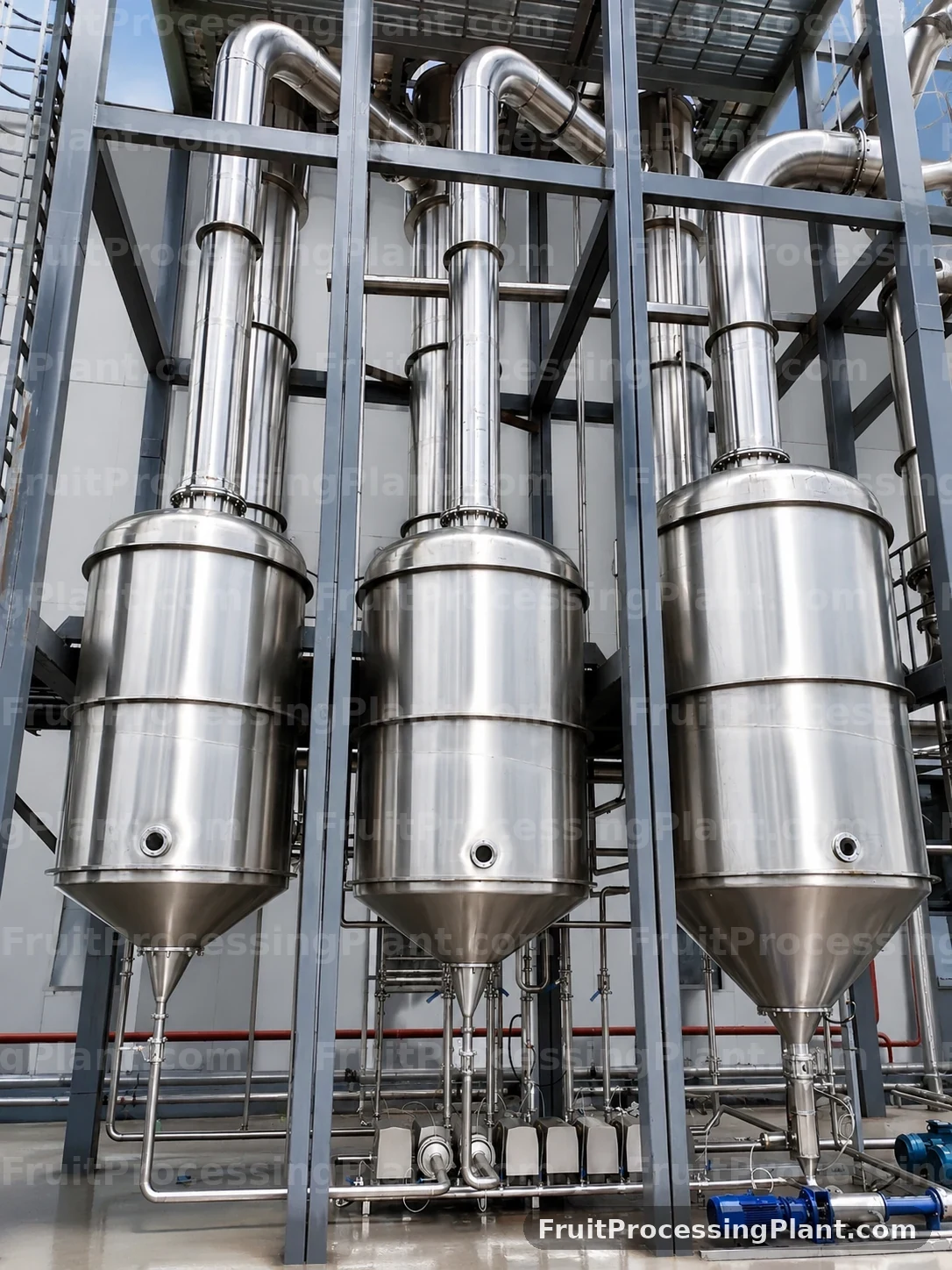
Evaporation and concentration
Product or service input
Suitable pumpable feed with known concentration, viscosity and wetting behaviour.
Output and interface
Concentrated product plus removed water vapour and condensate streams.
View the complete process dutyDiscuss this equipmentSelection boundary
Review film distribution, minimum wetting, heat sensitivity and fouling over the whole campaign.
High viscosity or poor wetting can defeat the selected film arrangement; assess turndown, not only maximum feed.
Cleaning and maintenance
Plan distributor inspection, cleaning coverage, condensate segregation and steam, vacuum and cooling interfaces.
Information that defines the proposed configuration
A model-specific offer must identify the equipment, verified duty and interfaces. The checks below identify required inputs, not guaranteed machine ratings.
Feed and target concentration
Product name, feed Brix, target Brix and whether values are measured or preliminary.
Feed Brix and target Brix define the water removal and mass balance.
Capacity
Feed flow per hour, operating hours, seasonal schedule and expected product output.
Flow and concentration ratio determine heat-transfer area and circulation duty.
Viscosity and fouling
Viscosity at relevant Brix and temperature, pulp, fiber, pectin, foam tendency and acceptable cleaning interval.
Fouling and viscosity determine evaporator type, pump selection and run length.
Quality target
Maximum product temperature, aroma recovery expectation, color sensitivity and heat exposure limit.
Quality limits affect vacuum level, effect arrangement and residence time.
Utilities and CIP
Steam pressure, cooling-water temperature, vacuum system preference, power, condensate handling, CIP recipe and drainage.
Steam, vacuum, cooling and cleaning conditions govern practical performance.
Engineering Notes for Falling Film Evaporator Selection
Falling Film Evaporator is commonly discussed for apple juice concentrate, fruit puree concentration, tomato and tropical fruit products, ingredient concentrate projects. The goal is to make this module work as part of a complete fruit and vegetable processing line, not as an isolated catalogue item.
Evaporation, deaeration and holding equipment affects Brix, aroma retention, foaming, oxidation and line stability. Falling film evaporation is normally discussed for lower-viscosity juice streams, while forced circulation may be considered for thicker or more fouling-prone products. Vacuum deaeration helps reduce entrained air before sterilization or filling, and buffer tanks stabilize flow between batch and continuous sections.
The important RFQ data are feed Brix, target Brix, viscosity, pulp or fiber content, foam tendency, heat sensitivity, cleaning interval and available steam or cooling water. Low-temperature vacuum concentration can protect quality, but the final design depends on real product behavior. For viscous puree or paste, fouling and pumping limits are often more important than nominal capacity. The RFQ checklist below should be used to confirm the sizing data before quotation.
- Confirm whether the product is clear juice, cloudy juice, puree, paste or concentrate.
- Define target Brix and allowable aroma or color change before choosing concentration technology.
- Check foam and air removal needs when filling accuracy or oxidation is a concern.
- Use capacity and Brix values as preliminary references until mass balance is reviewed.
Related planning pages: Brix calculator for preliminary mass balance, falling film evaporator, and forced circulation evaporator. Use them to compare equipment, plant routes and RFQ scope before final quotation.
Equipment FAQ
When is falling-film evaporation suitable?
Falling-film evaporation is commonly considered for lower-viscosity, pumpable juice streams where short residence time is useful. Product distribution and minimum wetting must still be checked across the expected operating range.
When is forced circulation considered?
Forced circulation may be considered when viscosity, solids or fouling make stable film flow difficult. Pumping energy and residence time must be balanced against run length and cleaning frequency.
Why are feed Brix and target Brix both required?
Both values are needed to calculate water removal, concentrate output and utility load. A target Brix alone does not show how much evaporation duty the equipment must provide.
Can Falling Film Evaporator be customized?
Yes. Capacity, product-contact or container-contact parts, motor and drive selection, controls, guarding, inlet and outlet arrangement, platform and line interfaces can be configured from the project data listed on this page. Final scope is confirmed before manufacturing.
Why is there no fixed online price for Falling Film Evaporator?
The same equipment name can cover different capacity, construction, controls, guarding, accessories and upstream or downstream interfaces. A fixed public price would hide those differences. The RFQ process confirms the required scope before a project quotation is prepared.