Process route review
We start with raw material condition and the required finished product, then compare juice extraction, pulping, concentration, thermal treatment and packaging routes.
FruitProcessingPlant.com supports industrial buyers who want to turn fruit and vegetable raw materials into juice, puree, concentrate, pulp, sauce, jam and finished packaged products through practical processing line design.
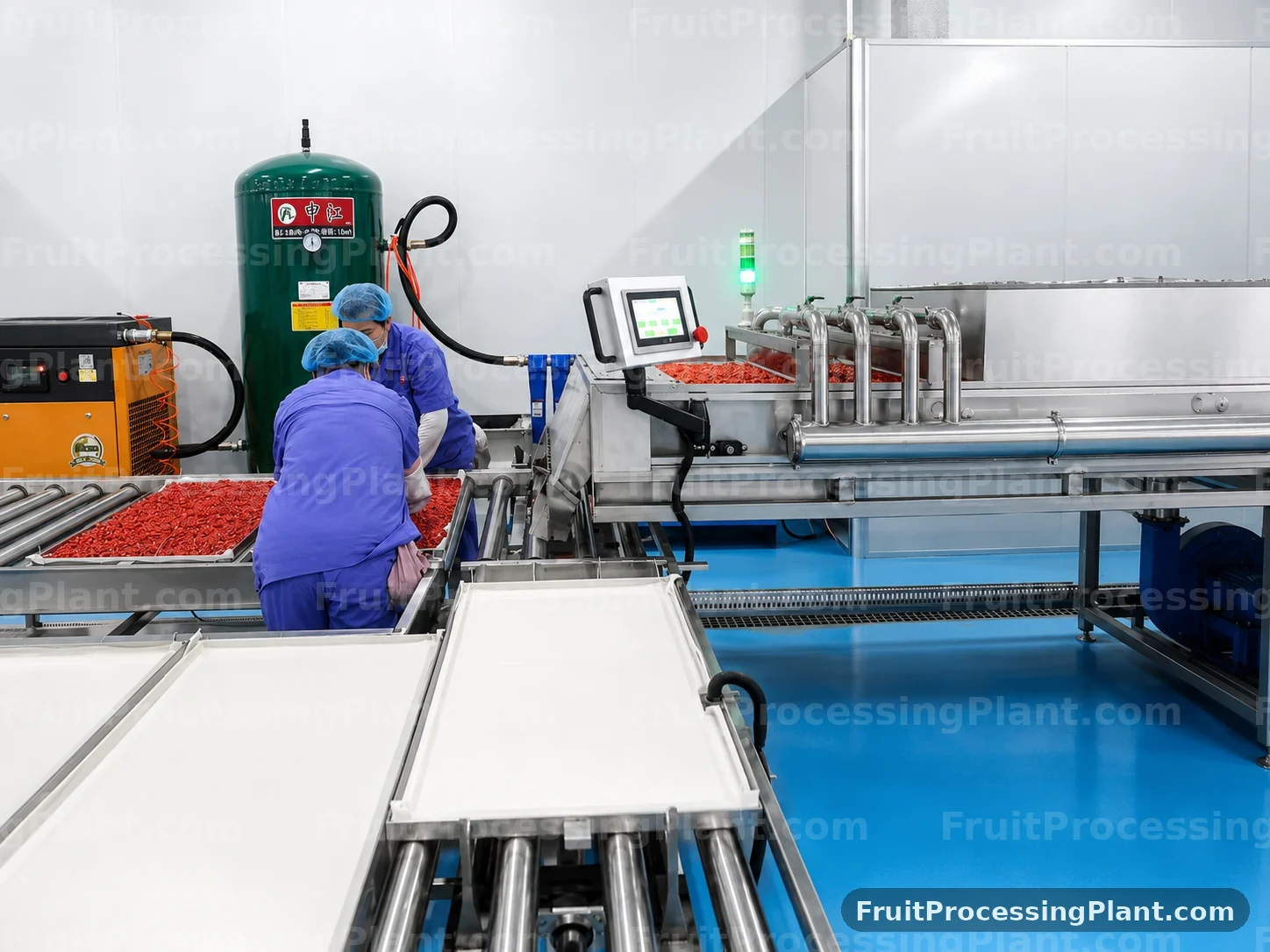
Our manufacturing coordination, process engineering and project communication work from the same Shanghai base. Buyers can use the location below when planning a technical meeting or factory visit. Please confirm the visit time with our team before travelling.
80 m north of the intersection of Pinxing Road and Shangsu Road, Fengxian District, Shanghai, China. Open in Bing MapsWe start with raw material condition and the required finished product, then compare juice extraction, pulping, concentration, thermal treatment and packaging routes.
Steam, power, cooling water, compressed air, drainage, CIP access and equipment interfaces are reviewed with the available factory space before the line scope is frozen.
Equipment drawings, control boundaries, factory acceptance checks, installation sequence and commissioning inputs are coordinated around the approved process route.
We work as a direct fruit and vegetable processing equipment manufacturer, not a broker passing inquiries from one supplier to another.
Our office and manufacturing team operate together in Shanghai, China. Sales communication, process engineering, production coordination and after-sales support stay close to the actual equipment build instead of being separated across several intermediaries.
Shanghai is one of China's major industrial, logistics and international business cities. This location helps us coordinate engineering communication, supplier resources, export documentation and customer visits for fruit processing plant projects.
After you send an RFQ, our engineers review the raw material, finished product, processing capacity, Brix, viscosity, packaging format, utility conditions and factory layout before proposing a customized processing route and equipment scope.
Our goal is simple: help more harvested fruit and vegetables become useful food products instead of waste.
Fresh fruit and vegetables are seasonal, perishable and often uneven in quality. A suitable processing line can turn surplus or time-sensitive raw material into juice, puree, pulp, concentrate, jam, sauce or aseptic bulk ingredients with a longer commercial life.
Processing plants help agricultural regions convert raw crops into higher-value products. Instead of selling only fresh produce, buyers can evaluate industrial routes for beverage bases, puree ingredients, concentrate, finished packs or semi-finished products for downstream factories.
Better processing planning can reduce waste, improve utilization and make cleaning, water, steam and energy use easier to manage. Environmental performance still depends on the final factory design, utility system and operating discipline, so we treat it as an engineering topic rather than a slogan.
We focus on complete fruit and vegetable processing line planning from raw material intake to filling and cleaning.
| Project Type | Typical Finished Product | Main Engineering Focus |
|---|---|---|
| Fruit juice processing line | NFC juice, clarified juice, nectar base or juice concentrate | Extraction route, Brix, acidity, deaeration, sterilization and filling format |
| Fruit and vegetable puree line | Mango puree, tomato puree, guava puree, apple puree, vegetable pulp | Fiber control, viscosity, pulping screen, heat treatment and aseptic filling |
| Concentrate and aseptic bulk line | Concentrate, puree concentrate or ingredient base | Evaporation, aroma loss, target Brix, fouling risk and bulk packaging |
| Finished packaged product line | Bottle, pouch, can, jar, drum or bag-in-bin products | Packaging size, shelf-life target, filling temperature, utilities and automation |
Fruit and vegetable supply varies by crop, harvest season, farm scale, maturity, defect rate and local purchasing model. A tomato project with stable daily supply is not the same as a seasonal mango, passion fruit or berry project. This is why processing capacity can vary widely from one RFQ to another.
Capacity is not only a number on one machine. It affects washing length, sorting labor, pulper size, tank volume, pump type, heat exchanger area, evaporator load, filling speed, CIP circuit and utility demand. Most equipment can be customized according to product, capacity and site conditions.
Juice, puree, concentrate, jam, sauce and aseptic bulk products need different process logic. Product viscosity, pulp, seeds, fiber, particles, target Brix, heat sensitivity and packaging format all influence whether a line needs a plate sterilizer, tubular sterilizer, tube-in-tube sterilizer, evaporator or aseptic filler.
Steam, power, compressed air, cooling water, floor layout, drainage, operator skill and automation requirement should be discussed before quotation. A line that looks correct on paper can still be difficult to run if utilities and cleaning access are not planned with the process.
After receiving project details, our engineers review the product target and prepare a process direction suitable for the requested capacity and raw material condition.
Fruit or vegetable type, fresh or frozen condition, maturity, seasonal supply, defect rate and whether sorting, peeling, destoning or trimming is required.
Juice, puree, pulp, concentrate, jam, sauce, aseptic bulk or finished retail package. This step decides the main process route.
Hourly capacity, daily capacity, batch size and expected operating schedule are reviewed because different regions and raw material bases need different line sizes.
Engineers match washing, sorting, crushing, pulping, deaeration, sterilization, evaporation, filling, CIP and PLC control modules to the product target.
The output is not a generic machine list. It is a process direction for discussion, with key technical questions marked for confirmation before a formal quotation.
These pages help buyers prepare clearer RFQ data before engineering review.
For an efficient response, send raw material, finished product, processing capacity, initial Brix, target Brix, viscosity or particle requirement, packaging format, utility conditions, factory layout, automation expectation and timeline. Reference values are acceptable for early planning, but final engineering must be confirmed by product data and project conditions.