
Product rheology
Use measured pH, Brix, viscosity, pulp and particle size to choose plate, tubular, tube-in-tube or retort treatment.
A tube-in-tube sterilizer provides wider flow channels for products with higher viscosity or particles. It is considered when plate heat exchangers are not suitable.
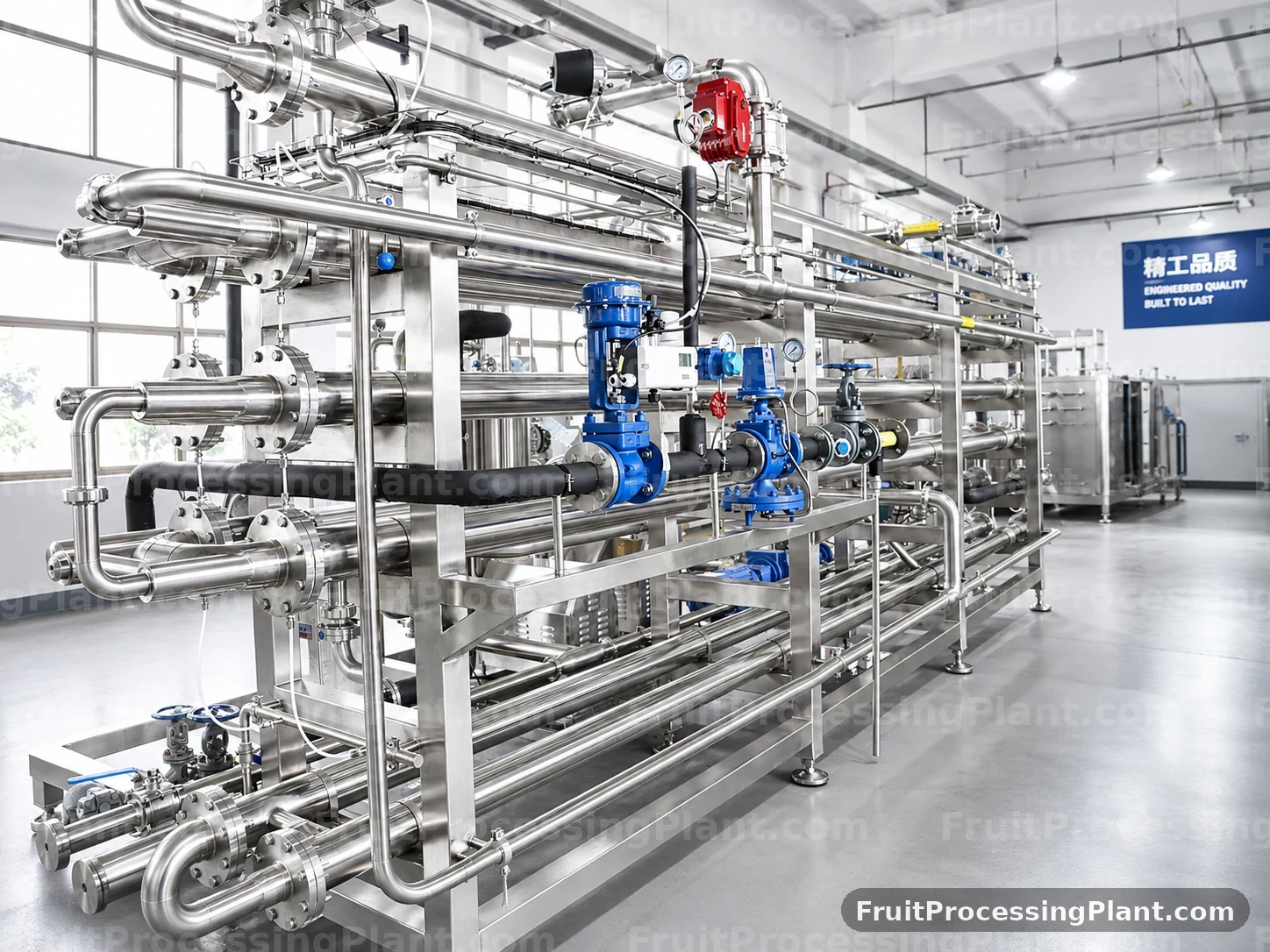
Tube-in-tube sterilizer for higher viscosity and particle-containing fruit products.
For Tube In Tube Sterilizer RFQ, provide product properties, capacity and operation, heat treatment and packaging interface. These data are used to confirm the configuration, interfaces and quotation scope.
The position may vary according to finished product route, plant layout and sanitary design.
Control feed rate, inlet height and raw material condition before Tube In Tube Sterilizer so the machine receives a stable load without bridging or unnecessary product damage.
Review this step with product data, line layout and sanitary requirements so Tube In Tube Sterilizer can be integrated without creating a bottleneck.
Confirm outlet height, pump or conveyor interface, buffer need and next-machine inlet so the section connects cleanly to the production line.
Provide access for inspection, drain-down and cleaning so product-contact parts can be maintained without excessive downtime.
Review this step with product data, line layout and sanitary requirements so Tube In Tube Sterilizer can be integrated without creating a bottleneck.
Tube In Tube Sterilizer is commonly discussed for high-viscosity puree, particle-containing sauce, fruit pulp with fiber, aseptic viscous products. The goal is to make this module work as part of a complete fruit and vegetable processing line, not as an isolated catalogue item.
Thermal equipment should be selected from viscosity, pulp content, particle size, acidity, packaging route and target shelf life. Low-viscosity clear juice may suit plate heat exchange, while pulpy juice, puree, sauce or concentrate often requires tubular or tube-in-tube handling. Preheating, holding, cooling, back-pressure and CIP access must be designed as one thermal system rather than as a single machine.
The buyer should provide product pH, Brix, fiber level, particle limits, filling temperature and storage target. Heat treatment that is too mild can create microbiological risk, while aggressive treatment can damage aroma, color and texture. The final sterilization or pasteurization condition must be confirmed by product testing and process validation; values on an early page are only a reference for discussion. The RFQ checklist below should be used to confirm the sizing data before quotation.
Related planning pages: plate sterilizer for low-viscosity products, tube-in-tube sterilizer for viscous products, and aseptic filling after sterilization. Use them to compare equipment, plant routes and RFQ scope before final quotation.
A tube-in-tube sterilizer is evaluated for viscous, pulpy or particle-containing products where passage geometry, pumping and cleaning are as important as nominal heat-transfer area.
| Design Check | What to Confirm | Engineering Effect |
|---|---|---|
| Product rheology | Provide Brix, viscosity at processing temperature, fiber level and particle passage requirement. | Product rheology determines tube clearance, pump selection, velocity and the risk of particle damage or blockage. |
| Hydraulic design | Confirm flow range, pressure drop limits and whether recirculation is allowed during start-up. | Pressure drop affects pump duty, residence-time control, mechanical design and aseptic transfer stability. |
| Thermal and fouling data | Describe inlet condition, target treatment, fouling behavior and any heat-sensitive quality limit. | Fouling behavior changes heat-transfer margin, run length, surface temperature and cleaning frequency. |
| Holding and cleaning | Define holding section requirements, CIP return conditions, cleaning chemistry and drain-down expectations. | Holding and CIP must be integrated with valves, sterile boundaries and the downstream aseptic filler. |
The questions below reflect the actual engineering inputs for this equipment category. Reference values are useful for early discussion, but final sizing is confirmed from project data and samples or drawings where needed.
Use measured pH, Brix, viscosity, pulp and particle size to choose plate, tubular, tube-in-tube or retort treatment.
Define inlet, treatment, holding and outlet temperatures together with target holding time and shelf-life route.
Coordinate back pressure, cooling, CIP or SIP, sterile transfer and filling temperature with the downstream package.
Use this checklist when requesting a quote for Tube In Tube Sterilizer. If values are preliminary, mark them as reference only so the engineering team can show adjustable options.
| RFQ Field | What to Provide | Why It Matters |
|---|---|---|
| Product properties | Product name, pH, initial Brix, viscosity at a stated temperature, pulp, fiber and maximum particle size. | Rheology and particles determine heat-exchanger geometry, pressure drop and fouling risk. |
| Capacity and operation | Product flow per hour, batch or continuous duty, operating hours and product change frequency. | Flow rate determines heat-transfer area, holding section and cleaning schedule. |
| Heat treatment | Inlet temperature, target treatment temperature, holding time, outlet temperature and required process validation basis. | Thermal duty controls heating medium, holding tube and cooling design. |
| Packaging interface | Aseptic, hot-fill, chilled or retort route, filling temperature, package format and required back pressure. | The package route changes cooling, sterile transfer and SIP requirements. |
| Utilities and cleaning | Steam pressure and quality, cooling-water temperature and flow, power, compressed air, CIP recipe, SIP requirement and drainage. | Steam, cooling and CIP availability determine achievable capacity and hygienic operation. |
The review focuses on viscous and particle-containing products, passage geometry, pressure drop, thermal holding, product recovery, fouling and CIP return conditions.
Use these checkpoints for early project evaluation. Final equipment selection requires confirmed product data, utility conditions and process requirements.
Direct answers below explain the decisions that change process scope, equipment selection and quotation quality.
Tube-in-tube is considered when viscosity, pulp, fiber or particles make narrow plate channels unsuitable or create excessive pressure drop and fouling. Plate equipment remains efficient for suitable low-viscosity products. Selection requires measured rheology, particle dimensions, required flow, thermal schedule, pressure limits and cleaning conditions rather than a product name alone.
Report the measurement method, spindle or geometry, shear condition and temperature together with the viscosity value. Product viscosity can change substantially during heating and concentration. A single ambient number may misrepresent pressure drop and heat transfer. Brix, pulp percentage and particle data should accompany the measurement for a useful engineering calculation.
Provide maximum length, width and thickness, particle concentration, shape, softness and whether particles must remain intact. These values affect passage clearance, pumps, valves and holding tubes. An average particle size is not enough because the largest acceptable piece and its behavior through bends determine blockage risk and finished-product quality.
Viscous puree or paste can represent valuable product remaining in pipes and heat exchangers at the end of a run. Recovery strategy affects piping slope, displacement medium, interfaces, tanks and cleaning sequence. It should be designed without compromising hygienic separation or mixing recovered material into product outside the agreed quality specification.
CIP review considers cleaning flow, velocity, temperature, chemical concentration, return path, drainability and the most difficult product-contact areas. Viscous and fibrous products may need specific pre-rinse and recovery steps. The complete circuit, including pumps, valves, holding tubes and filler connection, should be checked rather than cleaning the heat exchanger alone.
For a useful quotation, provide product properties, capacity and operation, heat treatment and packaging interface. Mark preliminary values as reference only.