
Product and gas load
Define product flow, viscosity, foam and entrained-air condition before selecting vacuum duty or tank residence time.
Storage and buffer tanks support stable feeding, temporary holding, blending or buffering between processing stages.
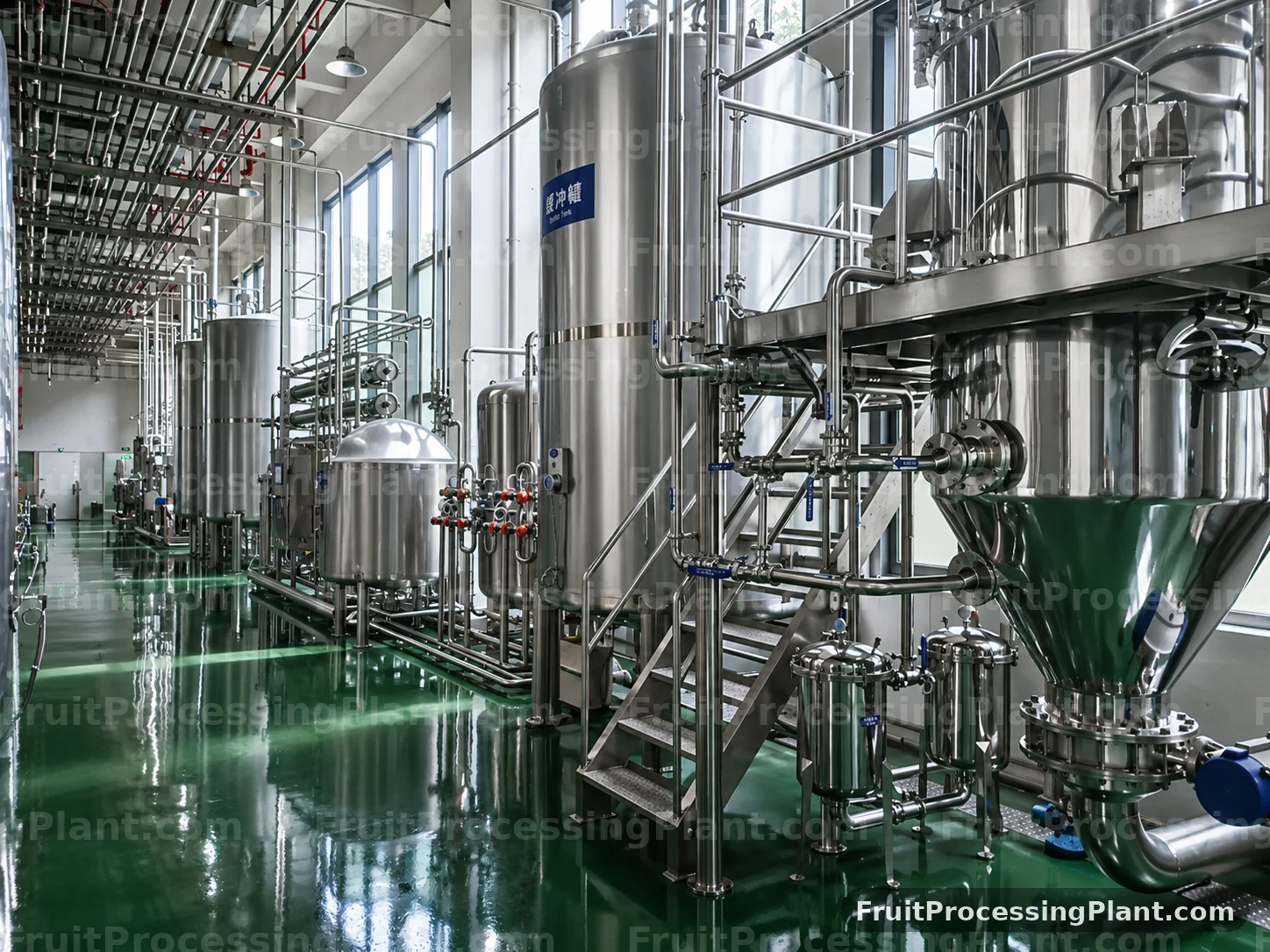
Storage and buffer tank for process stability in fruit processing plants.
For Storage & Buffer Tank RFQ, provide product and flow, required function, vacuum or pressure and controls and interfaces. These data are used to confirm the configuration, interfaces and quotation scope.
The position may vary according to finished product route, plant layout and sanitary design.
Control feed rate, inlet height and raw material condition before Storage & Buffer Tank so the machine receives a stable load without bridging or unnecessary product damage.
Review this step with product data, line layout and sanitary requirements so Storage & Buffer Tank can be integrated without creating a bottleneck.
Confirm outlet height, pump or conveyor interface, buffer need and next-machine inlet so the section connects cleanly to the production line.
Provide access for inspection, drain-down and cleaning so product-contact parts can be maintained without excessive downtime.
Review this step with product data, line layout and sanitary requirements so Storage & Buffer Tank can be integrated without creating a bottleneck.
Storage & Buffer Tank is commonly discussed for pre-sterilization buffer, post-evaporation storage, blending preparation, process balance control. The goal is to make this module work as part of a complete fruit and vegetable processing line, not as an isolated catalogue item.
Evaporation, deaeration and holding equipment affects Brix, aroma retention, foaming, oxidation and line stability. Falling film evaporation is normally discussed for lower-viscosity juice streams, while forced circulation may be considered for thicker or more fouling-prone products. Vacuum deaeration helps reduce entrained air before sterilization or filling, and buffer tanks stabilize flow between batch and continuous sections.
The important RFQ data are feed Brix, target Brix, viscosity, pulp or fiber content, foam tendency, heat sensitivity, cleaning interval and available steam or cooling water. Low-temperature vacuum concentration can protect quality, but the final design depends on real product behavior. For viscous puree or paste, fouling and pumping limits are often more important than nominal capacity. The RFQ checklist below should be used to confirm the sizing data before quotation.
Related planning pages: Brix calculator for preliminary mass balance, falling film evaporator, and forced circulation evaporator. Use them to compare equipment, plant routes and RFQ scope before final quotation.
The questions below reflect the actual engineering inputs for this equipment category. Reference values are useful for early discussion, but final sizing is confirmed from project data and samples or drawings where needed.
Define product flow, viscosity, foam and entrained-air condition before selecting vacuum duty or tank residence time.
State whether the module is for deaeration, surge control, recipe holding, cooling or sterile transfer.
Plan level control, agitation, vacuum, outlet pump, CIP return and upstream or downstream pressure together.
Use this checklist when requesting a quote for Storage & Buffer Tank. If values are preliminary, mark them as reference only so the engineering team can show adjustable options.
| RFQ Field | What to Provide | Why It Matters |
|---|---|---|
| Product and flow | Product type, flow per hour, temperature, viscosity, pulp, particles and foam tendency. | Product behavior determines vessel geometry, vacuum load, agitation and outlet pump. |
| Required function | Deaeration target, surge volume, holding time, mixing, cooling or sterile-buffer requirement. | The process function determines tank volume and internal components. |
| Vacuum or pressure | Required vacuum level, operating pressure, gas load and available vacuum source. | Vacuum and pressure data determine vessel design and gas-removal capacity. |
| Controls and interfaces | Inlet and outlet conditions, level range, pump interface, valve signals and upstream or downstream equipment. | Control interfaces keep flow stable between batch and continuous modules. |
| Cleaning and utilities | Product-contact material, CIP spray coverage, return route, cooling medium, power, air and drainage. | Cleaning and utility details affect hygiene and installation. |
Provide product flow, temperature, viscosity, foam tendency and the amount of entrained air or oxidation concern. These values determine vacuum duty, vessel residence time and outlet-pump arrangement.
Volume is selected from upstream and downstream flow variation, required residence time, product changeover and acceptable hold time. A larger tank is not always better for heat-sensitive products.
No. Agitation depends on settling risk, blending duty, heat transfer and product damage sensitivity. The RFQ should state whether uniformity, suspension or gentle holding is required.
Yes. Capacity, product-contact or container-contact parts, motor and drive selection, controls, guarding, inlet and outlet arrangement, platform and line interfaces can be configured from the project data listed on this page. Final scope is confirmed before manufacturing.
The same equipment name can cover different capacity, construction, controls, guarding, accessories and upstream or downstream interfaces. A fixed public price would hide those differences. The RFQ process confirms the required scope before a project quotation is prepared.
For a useful quotation, provide product and flow, required function, vacuum or pressure and controls and interfaces. Mark preliminary values as reference only.